CD Reviews #6 - Skylight
The amazing Steven Franklin

Performers: Steven Franklin, trumpet | Steven Franklin, piano
Composers: Johannes Brahms, Robert Schumann, Steven Franklin
Audio Engineer: Steven Franklin
Producer: Steven Franklin
Record Label: Steven Franklin
Favorite Track: Trumpet Sonata in B-flat major, Op. 14, Mvt. 2 - Andantino espressivo
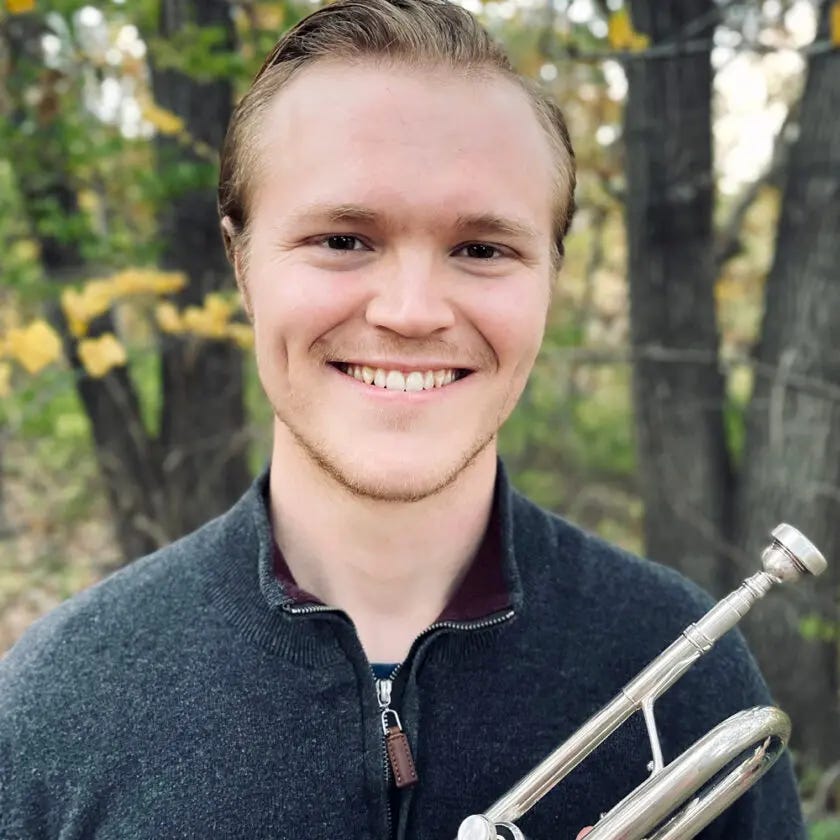
A tour de force. Steven Franklin, Principal Trumpet of the St. Louis Symphony, is not just a one man band, he is a one man production company; arranger, composer, trumpeter, pianist, audio engineer, etc. - he did it all for this album.
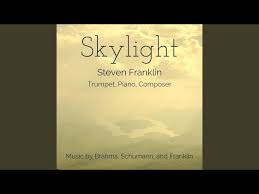
I love everything about this album. I love composer-performers, and I love musicians self-producing their albums, but Steven Franklin took it about four steps further with Skylight. Franklin composed, arranged, played trumpet, played piano, and did all the audio engineering - both production and post production - for this album.
Franklin is an accomplished composer, evidenced by the Op. 14 affixed to the front of his Trumpet Sonata, and by his catalog of (mostly) brass chamber music published by Saker Music. He is also an accomplished trumpet player, evidenced by his position of Principal Trumpet with the St. Louis Symphony. What could not be expected were his piano chops, technical wizardry, and the sheer doggedness it undoubtedly took to pull this project off. Remarkably, and I did confirm this, the first time Franklin actually heard his Trumpet Sonata was in post-production! This album is a tour de force, and should be celebrated as such.
Unfortunately it is not available as a CD (I made an exception to my rule), nor is it on Bandcamp or iTunes. It can only be found on Spotify and Apple Music. So sadly there are no convenient mechanisms to pay Steven Franklin for his music. You should, however, make an effort to discover his Venmo handle and send him all of your money right now.
To the music. My thoughts:
R. Schumman - Er, der Herrlichste von allen
Brahms - Wie Melodien zieht es mir
R. Schumman - Widmung
In these song transcriptions, Franklin makes the case for the trumpet as an intimate and beautiful chamber music instrument, not just a tool for military signals and Mahlerian climaxes. The Brahms is particularly beautiful. I found the Widmung interpretation to verge on the skittish in the piano part, but really, I durst not complain about the piano playing at all. The fact that “interpretation” is invoked speaks to the level of Franklin’s piano playing. He will need all of it for what he wrote in the Trumpet Sonata.
Steven Franklin - Trumpet Sonata in B-flat Major, Opus 14
Allegro agitato, ma non troppo
It is refreshing to hear a composer write beautiful melodies and develop them into a sustained narrative arc. It was not arbitrary that Franklin paired his trumpet sonata with songs by Brahms and Schumann. It could be said that his music is derivative, but all music is derivative, and that is not necessarily a bad thing after all. What really matters is a distinctive, personal voice, and Franklin has a distinctive voice that comes through. No doubt it will continue to develop and become more distinctive and personal over the years. He is a composer with immense talent, compositional craft, a gift for melodies, and the practical experience of performing and interpreting music himself.
My favorite track on the album. This movement has an ABA - Coda/B (refrain) form. It is a very Brahmsian form for a very Brahmsian affect, particularly in the A sections, where the nuanced, middle emotions of life are explored. The B section contains what I found to be the most beautiful music in the Sonata. Here Franklin does indulge the better nature of the trumpet and opens the heavens. I admit it brought a tear to my eye.
3. Allegro
I initially thought this was an ambiguous, medium tempo Brahmsian finale - but that turned out to simple be the slow introduction to a sonata-rondo movement! There are two types of sonata-rondo movements. The first is where the listener listens closely and identifies the elements of both sonata and rondo forms seamlessly molded together. The second is where the listener does not listen closely enough and can not tell if its is a sonata or rondo form. This movement is decidedly the latter. Complicating the matter is the faint suggestion of a reverse theme-and-variation (where the theme is reveled at the end). There is something in this movement very much suggesting Sibelius’s Finlandia tune, and it is so very nearly given in a full statement at the end that for a moment I thought I had solved the case and would have something noteworthy to report. But alas, the tune diverted, and the mystery of form remains unsolved till another listen.
Steven Franklin - Skylight for Five Trumpets
Skylight is arguably more “interesting” compositionally that the Trumpet Sonata. It is an argument I would not buy, but I say that as a consequence of it being less firmly anchored in tonality and being registrally compact, with many closely spaced chords in parallel motion. This contrasts with the Trumpet Sonata, which has busy piano textures that keeps all registers activated most of the time. The close spacing and compressed register is of course necessitated by the scoring for five trumpets (5x Franklin), but I am not complaining. Large groups of the same instrument playing closely spaced chords in parallel motion is a sound I adore. The trumpet sound, the use of those closely spaced chords, seconds, and stacked fourths or fifths (I always have a hard time recognizing the difference, but it hardly matters because they are basically the same thing), gives this piece an Aaron Copland/James Horner “Americana” sound. The stereophonic spacing of the trumpets was a also a pleasure on good headphones.
Steven Franklin is indeed a very talented man. I hope overtime that he will continue to blossom forth with his talents.
I consider myself as an informed listener. However, reading your review. I realized that there is levels of complexity which I have yet to understand.